
Bill book format
Download a customisable bill-book template in Excel, Word or PDF. GST law does not prescribe one visual bill format; the correct document type and applicable particulars determine whether it can be used as a tax invoice, bill of supply or ordinary commercial bill.
Download the bill-book format
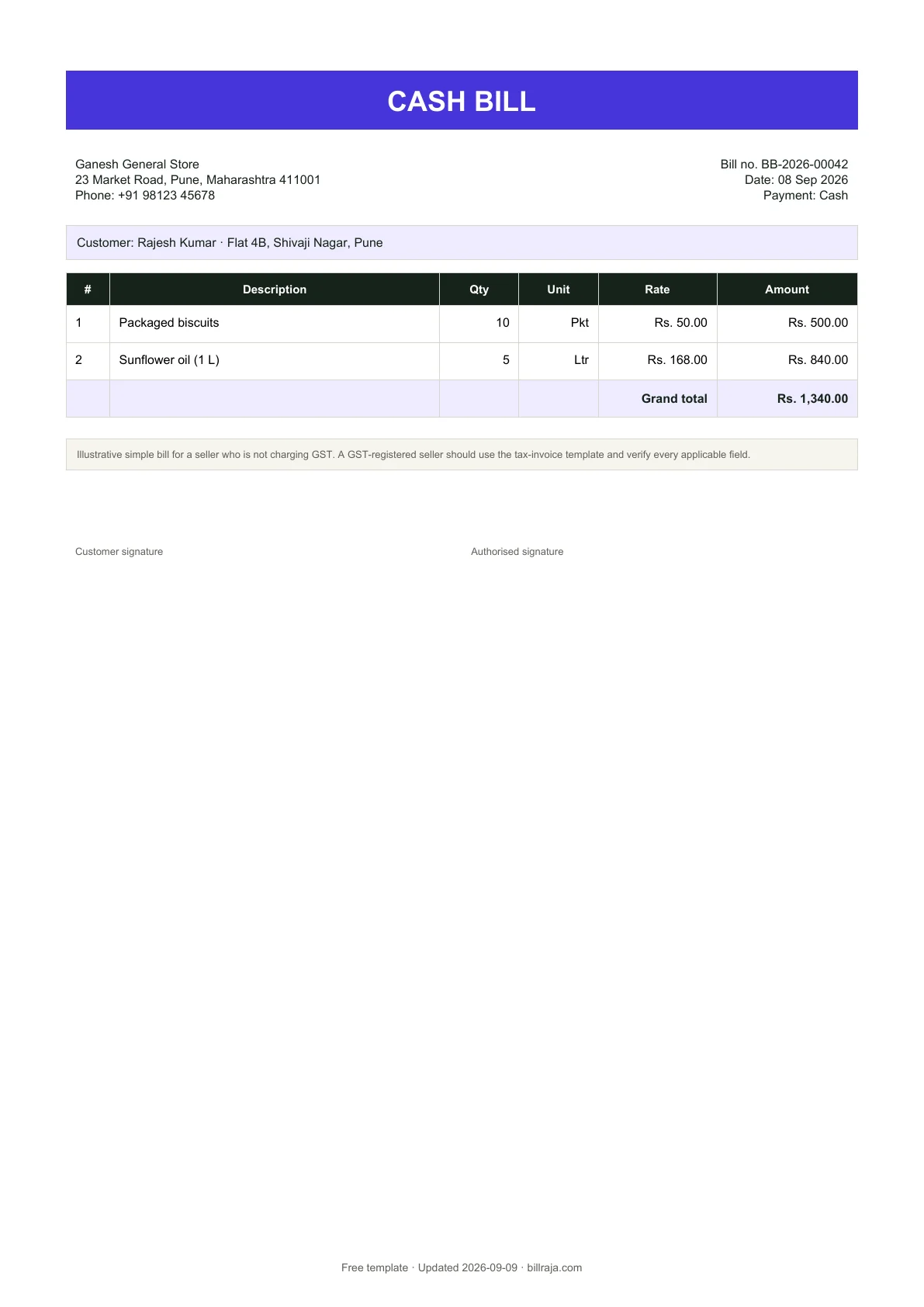
Each link points to a stable file. All three versions contain the same seller, customer, two items and ₹1,340 grand total.
Preview the complete A4 bill
This is the complete PDF—not a cropped table. Check the layout before downloading.
Reconciled sample total
| # | Description | Qty | Unit | Rate (₹) | Amount (₹) |
|---|---|---|---|---|---|
| 1 | Packaged biscuits | 10 | Pkt | 50.00 | 500.00 |
| 2 | Sunflower oil (1 L) | 5 | Ltr | 168.00 | 840.00 |
| Grand total | ₹1,340.00 | ||||
How to use this bill-book format
- Choose the correct document type: Use an ordinary bill if you are not charging GST. Registered sellers should decide whether the supply needs a tax invoice or a bill of supply.
- Download the template: Choose the editable Excel or Word file, or the print-ready A4 PDF.
- Add business and customer details: Replace the sample seller, customer, date, bill number and payment details with the real transaction details.
- Enter items and verify the total: Add each description, quantity, unit and rate. In Excel, the line totals and grand total calculate automatically.
- Number, save and share the bill: Use a traceable series, keep your copy with the underlying records, and print or share the customer copy.
GST registration and numbering are conditional
Do not treat “below ₹40 lakh” as a universal exemption. Registration depends on aggregate turnover, location, the type of supply and compulsory-registration rules. For a GST tax invoice, use a consecutive number of no more than 16 permitted characters that is unique for the financial year.
Registered persons ordinarily retain GST accounts and records for 72 months from the due date of the relevant annual return, and longer when proceedings or an investigation require it.
Official references and review status
- CGST Act Section 31: tax invoice and bill of supply
- Current consolidated Rule 46
- CGST Act Section 22: registration
- CGST Act Section 36: record retention
Review note: the arithmetic and file consistency were technically checked on 9 September 2026. Independent CA/GST-practitioner sign-off is still pending; verify classification and transaction-specific duties before issuing a statutory document.
Frequently asked questions
What is a bill book and who uses it?
Is a bill book the same as a GST tax invoice?
Is every business below ₹40 lakh unregistered?
What bill number format should I use?
How long should GST records be kept?
Can I download this format for free?
Related tools & guides
Ready to stop copying bills by hand? Use BillRaja.
Create numbered invoices, keep customer and item history, and share the finished bill from one workspace.