
GST invoice format
Download a customisable GST tax-invoice template designed around the particulars in Rule 46. GST law does not prescribe one visual format. The fields, HSN/SAC precision, tax rate, place of supply, e-invoice treatment and document type must still be verified for each transaction.
Download the GST invoice format
These are stable direct links. Each file contains the same illustrative Karnataka B2B transaction and Rule 46 review note.
Preview the complete A4 invoice
The full document is visible here so you can inspect seller, buyer, place-of-supply, line-item and total sections before downloading.
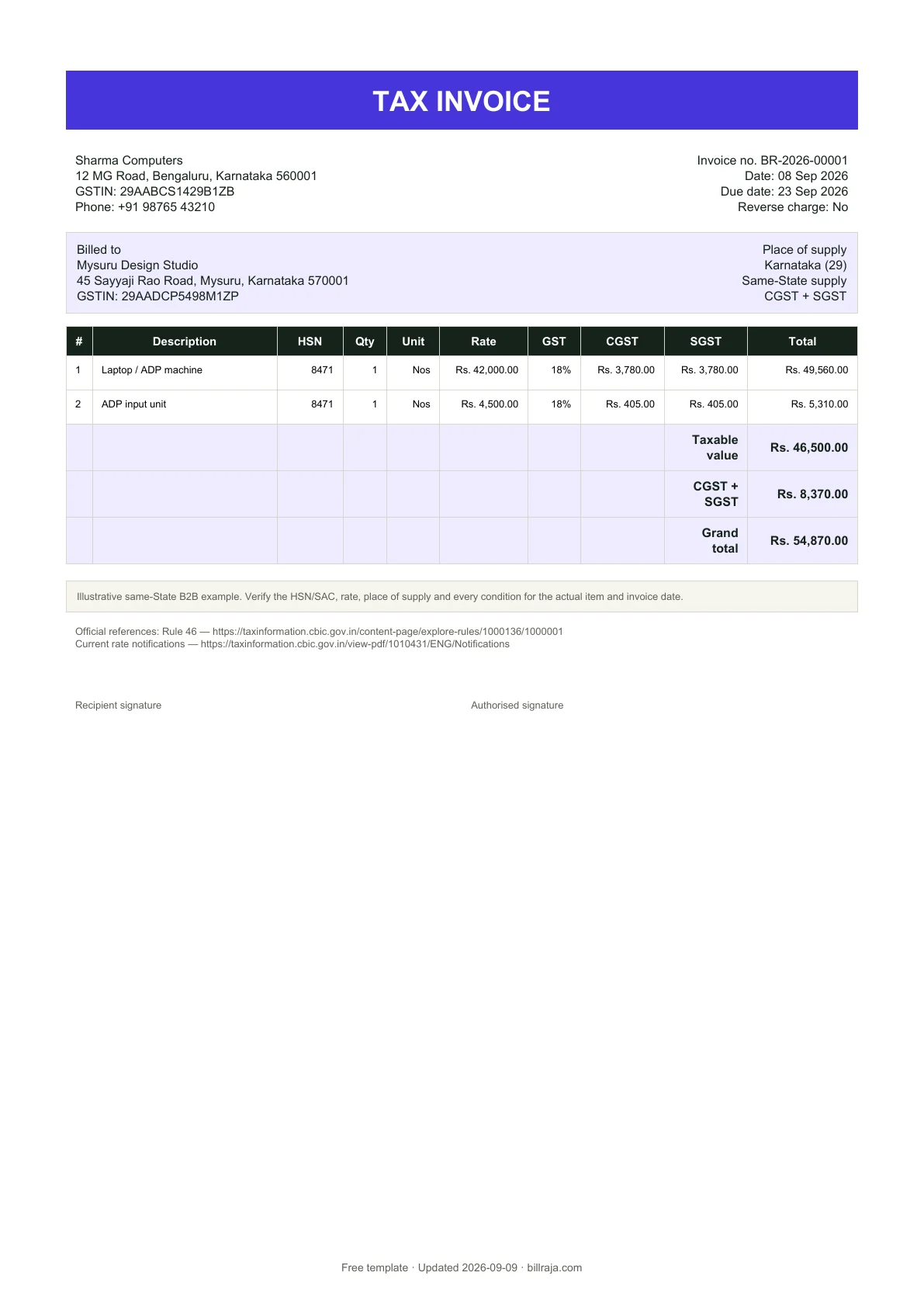
Reconciled same-State sample
| # | Description | HSN | Qty | Rate (₹) | GST | Taxable (₹) | CGST (₹) | SGST (₹) | Total (₹) |
|---|---|---|---|---|---|---|---|---|---|
| 1 | Laptop / ADP machine | 8471 | 1 Nos | 42,000.00 | 18% | 42,000.00 | 3,780.00 | 3,780.00 | 49,560.00 |
| 2 | ADP input unit | 8471 | 1 Nos | 4,500.00 | 18% | 4,500.00 | 405.00 | 405.00 | 5,310.00 |
| Grand total | 46,500.00 | 4,185.00 | 4,185.00 | ₹54,870.00 | |||||
Illustrative four-digit HSN heading. Verify the exact six- or eight-digit classification, rate and conditions for the actual product.
How to use this GST invoice format
- Choose Excel, Word or PDF: Download the editable workbook or document, or use the print-ready A4 PDF after previewing the full page.
- Replace the sample parties: Enter the supplier and recipient particulars that apply, including GSTIN and State details where required.
- Classify the supply: Verify the exact HSN or SAC, current rate, place of supply, reverse-charge treatment and any special invoice rule.
- Enter each line item: Add the description, quantity, unit and taxable rate. The Excel template calculates CGST, SGST and totals.
- Check and issue the invoice: Confirm every applicable Rule 46 field, the ₹54,870 sample arithmetic and any e-invoice requirement before signing or sharing.
Rule 46 particulars—apply the ones relevant to your supply
- Supplier name, address and GSTIN.
- Consecutive invoice number of no more than 16 permitted characters, unique for the financial year, plus issue date.
- Registered recipient’s name, address and GSTIN/UIN.
- For an unregistered recipient, the prescribed name, address, delivery address and State/code details at ₹50,000 or more, or below that value when requested.
- HSN/SAC, description, and quantity plus unit or UQC for goods.
- Total value, taxable value after discount or abatement, applicable tax rates and tax amounts.
- Place of supply and State for inter-State supplies, and delivery address when different.
- Reverse-charge status and signature or digital signature, subject to the electronic-invoice proviso.
- IRN-embedded QR code when Rule 48(4) applies, or the prescribed Rule 46(s) declaration when an above-threshold taxpayer is lawfully excluded.
- Required export/SEZ endorsements and destination particulars for those supplies.
Current Rule 46 also has special recipient-State wording for specified online money gaming, ECO and OIDAR supplies to unregistered recipients, irrespective of value. Certain suppliers have separate Rule 54 document rules.
Rates and HSN precision changed—verify the exact item and date
From 22 September 2025, the headline GST structure uses 5% and 18%, with 40% for specified demerit and luxury supplies. Nil/exempt entries and notified special schedules still exist. The example uses HSN heading 8471 at an illustrative 18%; never infer an item’s rate from a broad page label alone.
CBIC guidance uses six-digit HSN/SAC where preceding-financial-year aggregate turnover exceeds ₹5 crore, and four digits on B2B invoices for taxpayers up to ₹5 crore. GST return portal validations are separate and should be checked while filing.
Official references and review status
- Current consolidated Rule 46
- CBIC FAQ: invoice format and particulars
- Notification 9/2025—Integrated Tax (Rate)
- PIB FAQ on September 2025 rate changes
- CBIC HSN/SAC digit guidance
- GST Portal Table 12 advisory
Review note: the arithmetic and cross-format consistency were technically checked on 9 September 2026. Independent CA/GST-practitioner sign-off remains pending; verify the legal and classification details for the real transaction.
Frequently asked questions
Is there one government-prescribed GST invoice design?
Which particulars normally appear on a GST tax invoice?
When do CGST and SGST apply instead of IGST?
What GST rate structure applies after 22 September 2025?
How many HSN or SAC digits should an invoice show?
Does the ₹50,000 rule exempt an invoice from GST requirements?
Related tools & guides
Automate repeat invoicing.
BillRaja can reuse your customer and item details, apply the selected CGST/SGST or IGST treatment, and generate a shareable invoice.